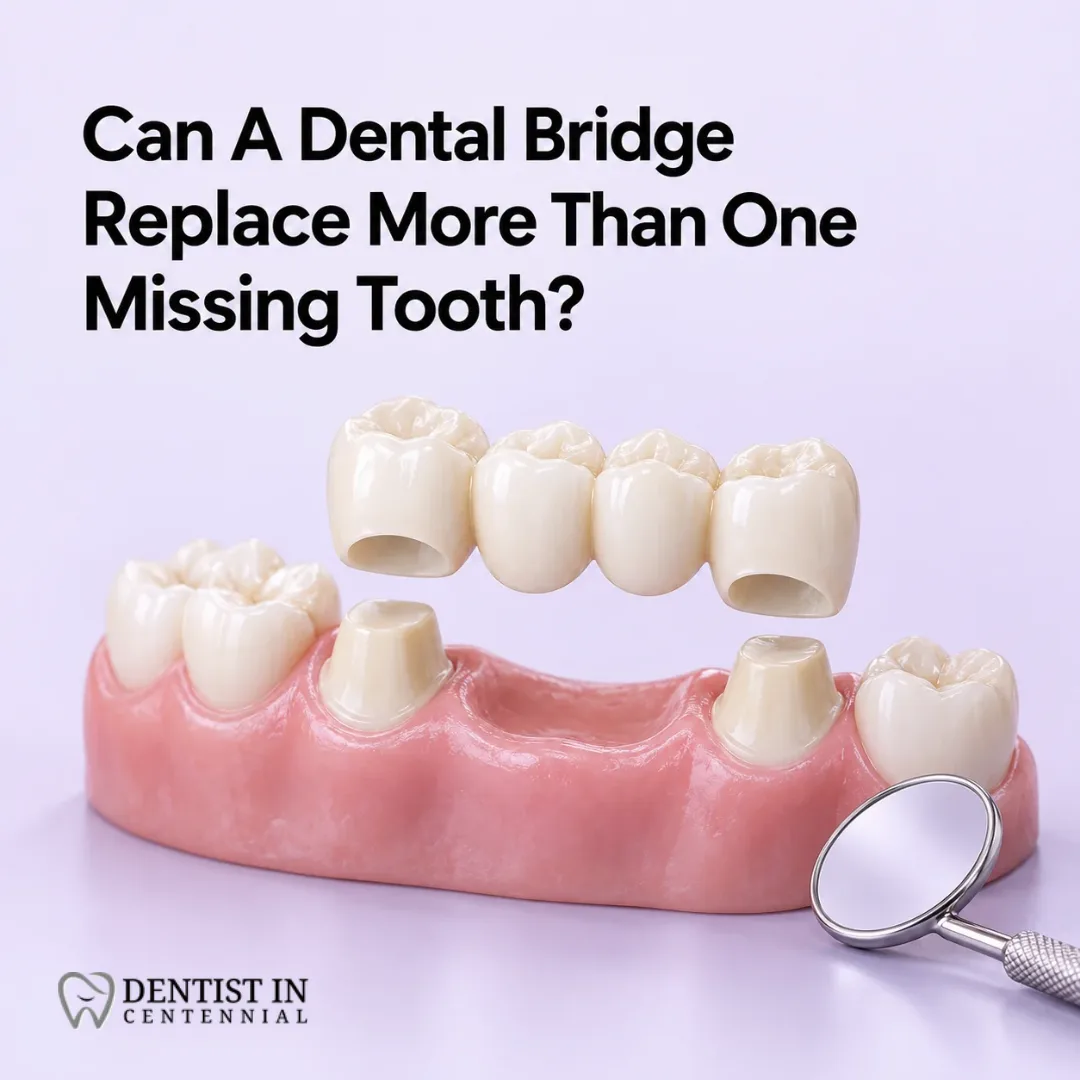
Many people lose a tooth and worry about chewing, speech, or smiling. They wonder if one bridge can fill more than one gap. This feels urgent and a bit scary for them.
A dental bridge can often replace two or three teeth in a row. The number depends on the health of the nearby teeth or whether implants are used. Here you will understand how bridges work, what limits how many teeth a bridge can replace, and when implants or other options make more sense.
A dental bridge fills the empty space left by missing teeth. It attaches to healthy teeth or implants nearby, creating a stable path for chewing and smiling again.
A fixed bridge links teeth on either side of a gap. It uses crowns on abutment teeth or implants to hold one or more pontics. Porcelain fused to metal or zirconia gives a natural look and strength.
Pontics replace missing teeth and restore chewing and speech. Dentists place crowns on adjacent teeth or on implant-supported posts for stability. Good gum health and solid abutment teeth matter for long term success.
Abutment teeth play a crucial role in supporting a dental bridge. These are the natural teeth on either side of the gap where teeth are missing. They act as anchors for the bridge.
Dentists prepare them by shaping or trimming them slightly to fit crowns over them. This process allows the fixed bridge to stay stable and secure in place.
Pontics fill the gap left by missing teeth. They sit between the abutment teeth, providing both function and aesthetics. Made from materials like porcelain or ceramics, pontics blend well with existing teeth.
Patients benefit from improved chewing abilities and enhanced smiles after getting your new dental prosthesis installed. The combination of abutment teeth and pontics creates an effective solution for tooth replacement that promotes overall oral health while restoring confidence in one's smile.
A dental bridge can replace one or more missing teeth, depending on the situation. Generally, it covers a gap by using adjacent teeth as anchors for added support and stability.
Bridges can replace one to several missing teeth.
| Type | Typical Teeth Replaced | Notes |
|---|---|---|
| Traditional fixed bridge | Usually 1 to 3 teeth | Uses two healthy teeth as anchors. Longer spans raise stress on anchors. Dentists often limit length to reduce risk. |
| Cantilever bridge | Often 1 tooth | Anchored on only one side. Best for locations with light chewing force. Not common for long gaps. |
| Maryland (resin-bonded) bridge | Typically 1 tooth | Conserves enamel. Good for front teeth with small gaps. Less durable for back teeth. |
| Implant-supported bridge | Commonly 2 to 4 teeth per span | Replaces several teeth without using natural teeth as anchors. Two implants can sometimes support three units. More implants increase stability. |
| Long-span bridge | More than 3 teeth, sometimes 4 or more | Higher failure risk with natural abutments. Often avoided when abutment teeth are weak. Implants can make long spans practical. |
| Full-arch solution | Many teeth, entire arch | Usually uses multiple implants. Standard bridge design alone rarely covers an entire arch. Clinicians plan case by case. |
The number of teeth a bridge can replace depends on several factors. First, the health of surrounding teeth plays a vital role. If the adjacent teeth are strong and stable, they can support more pontics.
These supporting teeth, known as abutment teeth, need to be in good shape for effective tooth replacement. Gum health also matters here; unhealthy gums may weaken the entire structure.
Second, the gap's location influences how many replacements fit comfortably. Multiple missing teeth in a row allow for longer bridges to fill that space effectively. However, non-consecutive gaps may require different solutions like dental implants or partial dentures instead of traditional bridgework.
Each situation varies greatly; therefore, it's essential for dentists to evaluate individual conditions carefully before making recommendations.
Replacing multiple teeth with a bridge involves careful attention to the health of surrounding teeth. Strong supporting teeth provide stability and ensure that the dental bridge functions well over time.
The health of supporting teeth or implants plays a vital role in using a dental bridge. Strong abutment teeth provide the needed stability for the fixed bridge. If these support structures are damaged or unhealthy, they might not hold up well over time. A dentist will usually examine them closely before placing a bridge.
Implants can also be used as anchors for a dental prosthesis. Healthy implants increase overall strength and improve oral health outcomes. Regular check-ups help maintain their condition and ensure proper function. Having strong supports makes tooth replacement easier and more effective in restoring smiles.
Replacing non-consecutive missing teeth can be tricky. People often seek alternatives to a dental bridge for various reasons. Here are some options:
Exploring these choices allows patients to find what suits their needs best while ensuring safe and effective solutions for tooth replacement and oral health preservation.
Yes, a dental bridge can replace multiple missing teeth. It connects to adjacent healthy teeth for support, creating a stable solution.
A dental bridge uses crowns on neighboring teeth as anchors. The false teeth fill the gaps in your smile, restoring function and appearance.
Absolutely! There are traditional bridges, cantilever bridges, and Maryland bridges. Each type serves specific needs based on how many teeth are missing and their location.
You will visit your dentist for an exam first; they will take impressions of your mouth to create the custom bridge. After that, you may need two visits: one for fitting and another for final adjustments once it is ready.
Tell us a little about what you need — we'll be in touch shortly.
20269 E Smoky Hill Rd, Centennial, CO 80015, United States

Hi! I'm Tooth fairy! Your AI Assistant Ask me anything